What Is Artificial Intelligence? The Ultimate Guide to How It Works, Real-Life Examples, and Top Tools (2026 Updated)
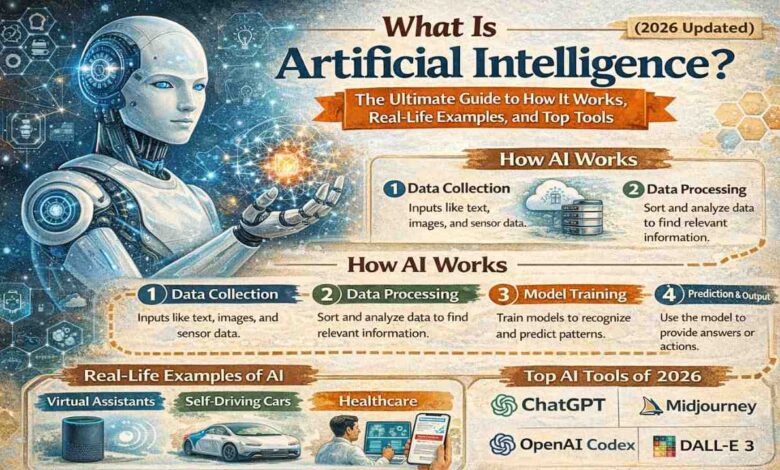
What Is Artificial Intelligence?
What is artificial intelligence? Artificial intelligence is the ability of computer systems to perform tasks that normally require human thinking, such as learning, reasoning, problem-solving, and understanding language. It works by processing large amounts of data, finding patterns, and making decisions based on those patterns. Modern AI powers everything from voice assistants to medical diagnosis tools.
AI vs Machine Learning vs Deep Learning: Quick Comparison
| Concept | Definition | Example | Relationship |
|---|---|---|---|
| Artificial Intelligence | Machines simulating human intelligence | Self-driving cars, voice assistants | The broadest category |
| Machine Learning | AI that learns from data without being explicitly programmed | Spam filters, Netflix recommendations | A subset of AI |
| Deep Learning | Machine learning using layered neural networks | Face recognition, image generation | A subset of machine learning |
| Natural Language Processing | AI that understands and generates human language | Siri, Google Translate | A branch of AI |
Introduction
We hear the term every day in tech news, product launches, and everyday conversation. But most people still ask the same basic question: what is artificial intelligence and how does it actually work?
Put simply, artificial intelligence is a branch of computer science focused on building machines that think, learn, and solve problems like humans do. From the moment you unlock your phone with your face to the way your email filters out spam automatically, AI is already shaping your daily life in ways you might not even notice.
This guide breaks down what is artificial intelligence from the ground up, covers real ai examples in real life, explains the ai vs machine learning debate, lists the best ai tools list available today, and highlights the genuine ai benefits that make this technology so important.
What Is Artificial Intelligence?
What is artificial intelligence in plain language? It is the science of building computer systems that can do things that would normally require human intelligence.
These things include:
- Understanding spoken and written language
- Recognizing images, faces, and objects
- Making decisions based on incomplete information
- Learning from experience and improving over time
- Solving complex problems faster than any human could
The term was first coined by computer scientist John McCarthy in 1956 at a conference at Dartmouth College. His definition was straightforward: making machines behave in ways that would be called intelligent if a human did the same thing.
Today, that definition has expanded dramatically as computing power, data availability, and algorithmic sophistication have grown.
How Does Artificial Intelligence Work?
Understanding how AI works requires looking at the three key processes that drive it: data input, learning, and output.
Step 1: Data Input
AI systems learn from data. The more data they receive, the better they perform. This data can be text, images, audio, video, numbers, or any other format that can be digitized.
For example, an AI trained to recognize cats needs to see thousands or millions of cat photos before it can reliably identify one on its own.
Step 2: Training and Learning
Once data is fed into an AI system, algorithms process it to find patterns. This training phase is where the machine “learns.”
In supervised learning, the AI is given labeled data (for example, photos marked “cat” or “not cat”). In unsupervised learning, the AI finds patterns on its own without labels. In reinforcement learning, the AI learns by trial and error, receiving rewards for correct actions and penalties for wrong ones.
Step 3: Output and Decision-Making
After training, the AI uses what it learned to make predictions or decisions on new, unseen data. A well-trained model can classify emails as spam, recommend a product, or identify a disease in a medical scan with remarkable accuracy.
Step 4: Continuous Improvement
Modern AI systems do not stop learning after initial training. They continuously update their models as new data comes in, which is why services like recommendation engines seem to know your preferences better over time.
AI vs Machine Learning:
The ai vs machine learning debate confuses many people, and understandably so. The two terms are often used interchangeably, but they are not the same thing.
Artificial intelligence is the broad concept of machines performing tasks that require human-like intelligence. It is the umbrella term that covers everything from simple rule-based systems to complex neural networks.
Machine learning is a specific method of achieving AI. Instead of being explicitly programmed with rules, a machine learning system learns from data on its own.
Think of it this way: all machine learning is AI, but not all AI is machine learning.
A chess program that follows pre-written rules is AI but not machine learning. A spam filter that improves itself by studying which emails users mark as spam is both AI and machine learning.
Understanding this distinction helps you evaluate tools, job descriptions, and news headlines much more accurately.
Types of Artificial Intelligence
AI comes in different forms depending on its capability level and function.
Narrow AI (Weak AI)
This is the most common type of AI today. Narrow AI is designed to perform one specific task very well. Examples include:
- Image recognition software
- Voice assistants like Siri and Alexa
- Recommendation algorithms on YouTube or Spotify
- Fraud detection systems in banking
Narrow AI cannot transfer its skills to a new task outside its training.
General AI (Strong AI)
General AI refers to a machine that can perform any intellectual task that a human can. It can reason, learn, and apply knowledge across different domains. True general AI does not yet exist, but it is the long-term goal of many researchers in the field.
Superintelligent AI
This is a theoretical concept referring to an AI that surpasses human intelligence in every domain. It remains speculative and is the subject of significant ethical and philosophical debate.
AI Examples in Real Life
AI examples in real life are everywhere once you know what to look for. Here are some of the most impactful applications across different industries.
| Industry | AI Application | Real Example |
|---|---|---|
| Healthcare | Disease diagnosis, drug discovery | Google DeepMind’s AlphaFold for protein folding |
| Finance | Fraud detection, credit scoring | PayPal’s real-time fraud prevention system |
| Transportation | Self-driving vehicles, route optimization | Tesla Autopilot, Google Maps traffic prediction |
| Retail and E-commerce | Product recommendations, inventory management | Amazon’s recommendation engine |
| Education | Personalized learning, automated grading | Duolingo’s adaptive learning system |
| Customer Service | Chatbots, virtual assistants | Bank of America’s virtual assistant Erica |
| Agriculture | Crop monitoring, yield prediction | John Deere’s precision farming AI |
| Entertainment | Content recommendation, deepfake detection | Netflix’s personalized recommendation system |
These ai examples in real life show that artificial intelligence is not a future concept. It is already deeply embedded in the systems and services you use every day.
Top AI Tools List for 2026
The ai tools list has grown dramatically in recent years. Whether you are a student, professional, or business owner, there are tools built specifically for your needs.
| Tool | Category | Best For | Pricing |
|---|---|---|---|
| Gemini (Google) | Conversational AI | Research, writing, analysis | Free / Pro plan available |
| Midjourney | Image generation | Creative professionals, designers | From $10/month |
| Grammarly | Writing assistant | Students, writers, professionals | Free / Premium from $12/month |
| Jasper | Content writing | Marketers, content teams | From $39/month |
| Notion AI | Productivity | Teams, project management | Add-on to Notion plans |
| Copilot (Microsoft) | Productivity AI | Office tasks, coding, search | Free / Pro from $20/month |
| Runway ML | Video generation | Video editors, filmmakers | Free / Pro from $12/month |
| ElevenLabs | Voice AI | Podcasters, content creators | Free / Starter from $5/month |
This ai tools list represents just a fraction of what is available. New tools launch every month, so it pays to stay current with developments in the space.
AI Benefits: Why Artificial Intelligence Matters
The ai benefits for individuals, businesses, and society are wide-ranging and genuinely significant. Here are the most important ones.
Speed and Efficiency
AI systems can process data and complete tasks in seconds that would take human teams days or weeks. This speed advantage is especially powerful in data analysis, customer service, and manufacturing quality control.
Accuracy and Consistency
Humans make mistakes, especially during repetitive tasks. AI maintains consistent accuracy over millions of repetitions without fatigue. Medical imaging AI, for example, can identify cancer markers in scans with accuracy rates that match or exceed those of experienced radiologists.
Cost Reduction
By automating repetitive processes, businesses reduce labor costs significantly. Customer service chatbots handle thousands of inquiries simultaneously at a fraction of the cost of human agents.
Personalization at Scale
One of the most commercially valuable ai benefits is the ability to personalize experiences for millions of users simultaneously. Streaming services, online stores, and news platforms all use AI to show each user content tailored specifically to their preferences.
Solving Complex Problems
AI can tackle problems that are simply too large for human teams to solve manually. Climate modeling, drug discovery, financial risk management, and logistics optimization all benefit enormously from AI’s pattern-recognition capabilities.
24/7 Availability
Unlike human workers, AI systems do not sleep, take breaks, or call in sick. This makes them ideal for monitoring systems, customer support, and security surveillance that require constant attention.
Key Subfields of Artificial Intelligence
What is artificial intelligence without understanding its main branches? Here is a quick overview of the core subfields that power modern AI applications.
Natural Language Processing (NLP)
NLP is the branch of AI that deals with understanding and generating human language. It powers voice assistants, translation tools, sentiment analysis software, and text summarization systems.
Computer Vision
Computer vision teaches machines to interpret and understand visual information from the world. It is the technology behind facial recognition, medical imaging analysis, self-driving car cameras, and quality control in manufacturing.
Robotics
Robotics combines AI with physical machines to create systems that can interact with the physical world. Modern robots use AI to navigate environments, pick and place objects, and perform surgical procedures with precision.
Expert Systems
These are AI programs that use a knowledge base of human expertise to solve specific problems. They are widely used in medical diagnosis, financial planning, and legal research.
Risks and Ethical Concerns Around Artificial Intelligence
Understanding what is artificial intelligence also means understanding its risks. No technology is without downsides, and AI is no exception.
Job displacement is one of the most debated concerns. Automation powered by AI threatens roles in manufacturing, customer service, data entry, and transportation. However, history shows that new technologies also create new categories of jobs over time.
Bias in AI systems is a serious issue. If an AI is trained on biased data, its decisions will reflect and sometimes amplify those biases. This has real consequences in hiring algorithms, loan approval systems, and criminal justice risk assessments.
Privacy concerns arise because AI systems require massive amounts of data, much of it personal. Surveillance technology, targeted advertising, and data collection practices all raise important questions about consent and security.
Misinformation powered by AI is a growing challenge. Deepfake videos, synthetic text, and AI-generated audio can be used to spread false information at scale.
Addressing these issues requires thoughtful regulation, transparent development practices, and ongoing public conversation about how we want AI to shape society.
Expert Tips for Understanding and Using AI Effectively
- Focus on outcomes, not the technology. When evaluating any AI tool, ask what problem it solves for you specifically, not just what it can do technically.
- Start with free tools. Most major ai tools list items offer free tiers. Experiment before committing to paid plans.
- Understand its limitations. AI systems make mistakes, hallucinate facts, and reflect the biases in their training data. Always verify important outputs independently.
- Learn the basics of prompt engineering. For conversational AI tools, how you ask a question dramatically affects the quality of the answer you receive.
- Stay updated through reliable sources. The field moves fast. Following organizations like MIT Technology Review keeps you informed with credible, expert-reviewed coverage.
The Future of Artificial Intelligence
The trajectory of AI development points toward several significant shifts in the next decade.
Multimodal AI systems that can process text, images, audio, and video simultaneously are already emerging and will become standard. This will dramatically expand the range of tasks AI can handle.
AI in scientific research is accelerating discoveries in biology, chemistry, and physics at an unprecedented rate. Drug development timelines that once took decades are shrinking to years.
Edge AI is moving processing power closer to devices rather than relying on cloud servers. This means faster, more private AI on smartphones, wearables, and home devices.
Regulation and governance frameworks are developing in the EU, USA, and globally. The next few years will see significant policy changes that shape how AI systems are built, deployed, and audited.
FAQ:
1. What is artificial intelligence in simple terms?
What is artificial intelligence in the simplest possible terms? It is technology that allows computers to think and learn like humans. Instead of following rigid, pre-written instructions for every possible situation, an AI system can analyze data, recognize patterns, and make decisions on its own. Everyday examples include the voice assistant on your phone, the spam filter in your email, the recommendations on your streaming service, and the navigation app that predicts traffic. AI ranges from simple rule-based programs to complex neural networks capable of generating text, images, and audio. It is one of the most transformative technologies in human history, touching nearly every industry and daily activity.
2. What are the main AI examples in real life that affect me daily?
The most common ai examples in real life that most people encounter daily include: the face unlock feature on your smartphone (computer vision), the “you might also like” recommendations on Netflix or Spotify (recommendation algorithms), spam filtering in your email inbox (natural language processing), voice assistants like Siri, Alexa, or Google Assistant (NLP and speech recognition), fraud alerts from your bank when an unusual transaction occurs (anomaly detection), and the suggested routes and traffic predictions in Google Maps (predictive modeling). These systems run quietly in the background of services you already use, which is why many people do not realize how much AI already shapes their daily experience.
3. What is the difference between AI vs machine learning?
The ai vs machine learning distinction is one of the most important concepts to understand in this field. Artificial intelligence is the broad goal of creating machines that can perform tasks requiring human intelligence. Machine learning is one specific method for achieving that goal, where a system learns from data rather than being programmed with explicit rules. Think of AI as the destination and machine learning as one road that leads there. Other roads include expert systems, rule-based logic, and robotics. In practice today, machine learning is the dominant approach to building AI, which is why the terms are often used interchangeably, even though they technically describe different things.
4. What are the biggest AI benefits for businesses?
The most impactful ai benefits for businesses include dramatic reductions in operational costs through automation, faster and more accurate data analysis for decision-making, the ability to personalize customer experiences at scale, 24/7 availability through automated customer service systems, improved quality control through computer vision in manufacturing, and faster product development through AI-assisted research. Businesses that adopt AI strategically gain significant competitive advantages in speed, cost efficiency, and customer satisfaction. According to McKinsey Global Institute, AI could add up to $13 trillion to the global economy by 2030, representing one of the largest value creation opportunities in modern business history.
5. Is artificial intelligence dangerous?
Whether what is artificial intelligence describes something dangerous depends heavily on how it is developed, deployed, and governed. Current AI systems do carry real risks: bias encoded in training data can lead to discriminatory outcomes in hiring, lending, and criminal justice. Deepfakes and synthetic media threaten truth and trust. Job automation may displace workers faster than new opportunities emerge. Privacy risks grow as AI systems collect and analyze more personal data. However, AI also saves lives through better medical diagnosis, makes roads safer through driver assistance systems, and accelerates solutions to climate change. The technology itself is neutral; the outcomes depend on the choices humans make in building and regulating it.
6. Which AI tools list should beginners start with?
If you are new to AI and want to start exploring, the best ai tools list for beginners includes free and easy-to-use options. Start with Gemini or Microsoft Copilot for general questions and writing assistance. Try Grammarly for improving your writing quality with AI feedback. Explore Canva’s AI image generation tools for creative projects without needing design skills. Use Google Lens for visual search and identification from your phone camera. These tools have intuitive interfaces, do not require technical knowledge, and have generous free tiers. Once you are comfortable with these basics, you can explore more specialized tools for your specific industry or creative interests.
7. How does AI learn from data?
AI learns from data through a process called training. During training, an algorithm is fed large amounts of example data and adjusts its internal parameters to minimize errors in its predictions. In supervised learning, the training data is labeled so the model knows what the correct answer is and learns to replicate it. In unsupervised learning, the model finds hidden patterns in unlabeled data on its own. In reinforcement learning, the model learns through trial and error, receiving positive or negative feedback based on the outcomes of its actions. The quality and quantity of training data directly determines how accurate and reliable the resulting AI model will be.
8. What jobs are most at risk from AI automation?
Jobs most at risk from AI automation are those involving repetitive, rule-based tasks with predictable inputs and outputs. These include data entry clerks, customer service representatives handling routine inquiries, assembly line workers, basic accounting and bookkeeping roles, and transportation drivers as self-driving technology matures. Jobs that require creativity, complex human judgment, emotional intelligence, physical dexterity in unpredictable environments, and high-stakes interpersonal relationships are far less vulnerable in the near term. The World Economic Forum estimates that while AI will displace millions of jobs, it will also create new categories of employment in AI development, oversight, ethics, and complementary human-AI collaboration roles.
9. What is natural language processing and how does it relate to what is artificial intelligence?
Natural language processing (NLP) is a specific branch of what is artificial intelligence focused on enabling machines to understand, interpret, and generate human language. It is the technology behind every system that processes text or speech: voice assistants, translation apps, email spam filters, customer service chatbots, and text summarization tools all run on NLP. Modern NLP systems use deep learning models trained on enormous text datasets to predict and generate language that sounds natural. NLP represents one of the most commercially successful and rapidly advancing areas of AI research, with applications growing in virtually every industry that involves communication, documentation, or customer interaction.
10. How can I learn more about artificial intelligence?
The best way to deepen your understanding of what is artificial intelligence depends on your starting point and goals. For beginners, online learning platforms like Coursera, edX, and Khan Academy offer free and low-cost introductory courses. Google and IBM both offer free AI fundamentals certifications. For current news and research, MIT Technology Review and Stanford HAI (Human-Centered AI) publish accessible, expert-reviewed content. For hands-on experience, experimenting with free tools on the ai tools list teaches you more than reading alone. For deeper technical understanding, Python programming and courses in machine learning statistics build the foundation for advanced study. The field rewards curiosity and consistent learning above all else.
Conclusion
Understanding what is artificial intelligence is no longer optional for anyone who wants to navigate the modern world effectively. From the ai examples in real life that already shape your daily routines, to the growing ai tools list that can boost your productivity and creativity, to the very real ai benefits transforming healthcare, business, and science, artificial intelligence is the defining technology of our time.
The ai vs machine learning distinction helps you think more clearly about what you read and hear. The risks are real and deserve serious attention. But so are the opportunities for those who take the time to understand and engage with this field thoughtfully.
Start small. Pick one tool from the ai tools list, explore it with curiosity, and build your understanding from there. The more you engage with AI on your own terms, the better equipped you will be to use it, question it, and help shape how it develops.