How to Apply for Scholarships as an International Student (2026 Updated)
How to Apply for Scholarships in the USA
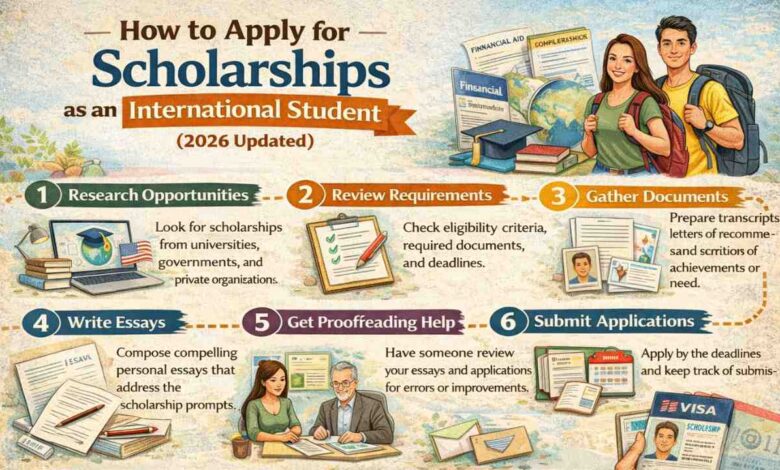
To apply for scholarships in the USA as an international student, identify scholarships you qualify for, check eligibility requirements carefully, gather your documents checklist (transcripts, test scores, recommendation letters, and financial proof), write a strong personal statement, and submit applications before deadlines. Start at least 12 months in advance for the best results.
Top US Scholarships for International Students at a Glance
| Scholarship Name | Funding Type | Amount | Who Can Apply | Deadline (Approx.) |
|---|---|---|---|---|
| Fulbright Foreign Student Program | Full funding | Full tuition + living | Graduate students worldwide | Varies by country |
| Hubert H. Humphrey Fellowship | Full funding | Full tuition + stipend | Mid-career professionals | Varies by country |
| Aga Khan Foundation Scholarship | Need-based | Up to full cost | Developing country students | March/April annually |
| AAUW International Fellowships | Merit + need | $18,000 to $30,000 | Women not from USA | November annually |
| Joint Japan/World Bank Scholarship | Full funding | Full tuition + travel | Developing country nationals | April annually |
| University Merit Scholarships | Merit-based | $5,000 to full tuition | All international students | With admission deadline |
Introduction
Studying in the United States is the dream of millions of students around the world. But the cost can feel impossible to overcome without financial help. The good news is that billions of dollars in scholarship funding are available specifically for international students every single year. The challenge is knowing where to look and how to apply correctly.
This complete study in USA guide breaks down the scholarship application process into clear, manageable steps. From building your documents checklist to preparing for interview prep, finding the right scholarship guide, and understanding the visa guide requirements that go alongside your funding, this article covers it all so you can apply with confidence and maximize your chances of success.
What Is a Scholarship for International Students?
A scholarship is a financial award given to students based on merit, financial need, field of study, nationality, or a combination of these factors. Unlike student loans, scholarships do not need to be repaid.
For international students applying to US universities, scholarships can cover:
- Full or partial tuition fees
- Housing and meal expenses
- Health insurance
- Travel costs (flights to and from the USA)
- Monthly living stipends
- Books and academic supplies
Understanding what each scholarship covers is a critical part of building your personal scholarship guide, because some awards look large on paper but only cover a narrow slice of actual costs.
Why Scholarships Matter for International Students
International students in the USA are generally not eligible for US federal financial aid programs like FAFSA. This means they must rely on scholarships, institutional grants, and private funding to make studying abroad financially possible.
The average cost of attending a US university ranges from $35,000 to $80,000 per year when you factor in tuition, housing, health insurance, and living expenses. Without substantial scholarship support, very few families from developing countries could realistically afford this.
This is exactly why having a solid study in USA guide for scholarships is so important. A well-planned application strategy can cut your costs dramatically or eliminate them entirely.
Types of Scholarships Available for International Students
Merit-Based Scholarships
These awards are given based on your academic performance, standardized test scores, leadership activities, and personal achievements. Many US universities automatically consider international applicants for merit scholarships when they apply for admission.
Strong GPA, high TOEFL or IELTS scores, and exceptional extracurricular achievements all improve your chances significantly.
Need-Based Scholarships
Need-based awards are determined by your family’s financial situation. Schools like Harvard, Yale, Princeton, and MIT offer some of the most generous need-based aid packages in the world, even for international students.
You will typically need to submit a CSS Profile or your university’s own financial aid form alongside detailed family financial documentation.
Government-Funded Scholarships
Both the US government and foreign governments offer funded scholarships for international study. The Fulbright Program is the most well-known US government scholarship for graduate-level international students. Many home country governments, including those of Pakistan, India, Ghana, and Brazil, also fund scholarships for their citizens to study in the USA.
University-Specific Scholarships
Most US universities have their own scholarship programs for international students. These range from small awards of a few thousand dollars to full-tuition presidential scholarships. Always check the financial aid page of every university you apply to.
Private and External Scholarships
Corporations, non-profit organizations, and foundations offer hundreds of scholarships to international students. These are often underutilized because applicants do not know they exist. Organizations like the Rotary Foundation, the Ford Foundation, and the American Association of University Women all run active programs.
Step-by-Step: How to Apply for Scholarships in the USA
Step 1: Research Available Scholarships Early
Start your search at least 12 to 18 months before your intended program start date. Many major scholarships have deadlines a full year before classes begin.
Best resources for scholarship research:
- EducationUSA maintained by the US Department of State
- Your target university’s international student financial aid page
- Your home country’s Ministry of Education or HEC (if applicable)
- Scholarships.com and Fastweb for external private awards
- Your country’s US Embassy website for bilateral scholarship programs
Build a spreadsheet listing each scholarship, its deadline, requirements, award amount, and application status. Treating this like a project keeps you from missing critical deadlines.
Step 2: Check Eligibility Requirements Carefully
Not every scholarship is open to every student. Before spending time on an application, confirm you meet all eligibility criteria.
Common eligibility factors include:
- Nationality or country of origin
- Academic level (undergraduate, graduate, PhD)
- Field of study or major
- Minimum GPA or test score requirements
- English language proficiency (TOEFL or IELTS score)
- Financial need threshold
- Age limits (some scholarships have maximum age requirements)
Applying for scholarships you clearly do not qualify for wastes your time and energy. Focus on the ones where you meet every single requirement.
Step 3: Build Your Complete Documents Checklist
A complete and well-organised document checklist is the backbone of a strong scholarship application. Missing even one document can disqualify your entire application.
| Document | Purpose | Tips |
|---|---|---|
| Academic Transcripts | Proves academic performance | Get official sealed copies translated if needed |
| English Test Scores (TOEFL/IELTS) | Proves English proficiency | Request official score reports early |
| Standardized Test Scores (GRE/GMAT/SAT) | Proves academic aptitude | Check if required by each specific scholarship |
| Personal Statement / Essay | Explains your goals and motivation | Tailor to each scholarship’s specific mission |
| Letters of Recommendation | Third-party endorsement of your abilities | Request from professors or employers 2 to 3 months early |
| Financial Documents | Proves financial need | Bank statements, tax returns, family income proof |
| CV or Resume | Summarizes academic and professional background | Keep it concise and achievement-focused |
| Passport Copy | Confirms nationality and identity | Must be valid for at least 2 years beyond study period |
| University Acceptance Letter | Confirms enrollment at a US institution | Some scholarships require this before applying |
| Research Proposal (for PhD) | Outlines your academic research plan | Must align with your chosen faculty supervisor’s work |
Step 4: Write a Powerful Personal Statement
Your personal statement is often the most important part of your scholarship application. It is your chance to tell your story in a way that numbers and transcripts cannot.
A strong personal statement should answer these questions:
- Why do you want to study in the USA specifically?
- What are your long-term career and community goals?
- How will this scholarship help you achieve those goals?
- What makes you stand out from other applicants?
- How will you use your education to benefit your home country?
Writing tips for your personal statement:
- Write in clear, simple, first-person language
- Open with a compelling story or specific moment that shaped your goals
- Be specific, not vague (avoid clichés like “I have always loved learning”)
- Show how your past experiences lead logically to your future plans
- Connect your goals directly to the scholarship’s stated mission
- Keep it within the word limit and edit ruthlessly for clarity
Have at least two people review your statement before submitting. A fresh set of eyes catches errors and unclear passages that you might have missed after reading your own work too many times.
Step 5: Secure Strong Letters of Recommendation
Most scholarships require two to three letters of recommendation from professors, academic supervisors, or professional mentors. These letters carry significant weight in the selection process.
How to get strong recommendation letters:
- Ask professors who know you well and have seen your work up close
- Give your recommenders at least 6 to 8 weeks of notice before the deadline
- Provide them with a copy of your CV, personal statement, and information about the scholarship
- Remind them gently one to two weeks before the deadline if they have not submitted yet
- Always send a thank-you note after the letter is submitted
A generic or lukewarm letter can hurt your application more than help it. Choose recommenders who are genuinely enthusiastic about your potential.
Step 6: Prepare for Scholarship Interviews
Many competitive scholarships, including the Fulbright and Hubert H. Humphrey programs, require a formal interview as part of the selection process. Solid interview prep is non-negotiable at this stage.
Common scholarship interview questions:
- Why did you choose this field of study?
- What are your plans after completing your degree?
- How will you contribute to your community or country after graduation?
- What challenges have you overcome in your academic or personal life?
- Why are you the best candidate for this scholarship?
- How does this scholarship align with your long-term goals?
Interview prep strategies:
- Practice your answers out loud, not just in your head
- Record yourself and watch it back to catch nervous habits
- Ask a mentor or teacher to conduct a mock interview
- Research the scholarship organization’s mission and values thoroughly
- Dress professionally even if the interview is conducted online
- Prepare two or three thoughtful questions to ask the interviewer at the end
Step 7: Submit Applications Before Deadlines
Late applications are almost always rejected, no matter how strong they are. Set your personal deadline at least two weeks before the official scholarship deadline.
This gives you time to fix technical issues, collect missing documents, or revise your personal statement one final time.
Create a calendar with all your scholarship deadlines, application portal logins, and required materials. Use reminders on your phone or a project management tool to stay on track.
How to Combine Scholarships with Your Visa Guide
Winning a scholarship is only one part of the equation. You still need a valid student visa to enter and study in the USA. Your scholarship award letter is actually a powerful asset in the visa application process.
A strong visa guide strategy integrates your scholarship documentation into your visa application package. Here is how:
- Include your scholarship award letter in your financial documents for the DS-160 application
- Use the scholarship letter to demonstrate strong financial support during your visa interview
- Make sure your I-20 from your university reflects the scholarship funding being applied to your account
- Scholarships from prestigious organizations like Fulbright actually signal to visa officers that you are a serious academic candidate with strong institutional backing
Refer to the official US Department of State Student Visa page for the most updated visa requirements and how scholarship documentation fits into the process.
Study in USA Guide: Scholarship Application Timeline
| Timeline Before Program Start | Action Steps |
|---|---|
| 18 months before | Begin scholarship research, take standardized tests, build initial documents checklist |
| 15 months before | Shortlist 10 to 15 scholarships, contact potential recommenders |
| 12 months before | Apply to universities, start writing personal statements, submit early scholarship applications |
| 9 months before | Submit remaining scholarship applications, attend scholarship interviews if required |
| 6 months before | Receive scholarship results, receive I-20 from university, begin visa guide process |
| 4 months before | Apply for student visa, complete interview prep for visa appointment |
| 1 to 2 months before | Receive visa, book flights, arrange housing, confirm scholarship disbursement details |
Common Mistakes International Students Make When Applying for Scholarships
Even strong candidates make avoidable errors. Here are the most common mistakes and how to fix them:
Applying to too few scholarships. Most students apply to three to five scholarships and then wait. Apply to at least 10 to 15. Scholarship acceptance rates are low, and volume gives you better odds.
Using the same personal statement for every application. Each scholarship has a unique mission. Copying and pasting without tailoring your statement signals a lack of genuine interest.
Missing deadlines. This is the most common and most preventable mistake. Set calendar reminders well in advance.
Ignoring smaller scholarships. Students often chase only the big, fully-funded awards and ignore $2,000 to $5,000 scholarships. Smaller awards add up and can cover significant portions of living expenses.
Providing incomplete documents. A missing transcript or an unsigned form can disqualify your entire application. Use a thorough documents checklist for every submission.
Asking for recommendation letters too late. Professors and supervisors are busy. Asking two weeks before a deadline often results in rushed or incomplete letters.
Expert Tips to Win Scholarships as an International Student
These strategies come from scholarship winners and admissions experts who have navigated this process successfully:
- Start your English test preparation early. High TOEFL or IELTS scores open far more scholarship doors. Invest in preparation materials at least six months before testing.
- Build a relationship with faculty before applying. Many scholarships ask for a faculty supervisor or mentor at the university. Emailing professors whose research aligns with your interests before applying can open doors that other candidates miss.
- Apply for your home country’s scholarship programs first. Programs like Pakistan’s HEC scholarships, Kenya’s government fellowships, or Brazil’s CAPES funding often have less competition than international open scholarships.
- Use your unique story as a strength. Scholarship committees read thousands of applications. Authentic stories about overcoming real challenges stand out far more than polished but generic essays.
- Network with current scholarship holders. Join communities on LinkedIn or university Facebook groups where Fulbright or similar scholars share their experience. They often share insider tips that are not publicly available.
- Invest in your interview prep as much as your written application. Many highly qualified candidates lose scholarships at the interview stage because they did not practice enough.
Scholarship Comparison: Full Funding vs. Partial Funding
| Feature | Full Funding Scholarships | Partial Funding Scholarships |
|---|---|---|
| Tuition Coverage | 100% covered | Partial (varies) |
| Living Expenses | Monthly stipend included | Usually not included |
| Health Insurance | Usually included | Rarely included |
| Travel Allowance | Often included | Usually not included |
| Competition Level | Extremely competitive | Moderate competition |
| Number Available | Limited (hundreds per year) | Wider availability (thousands) |
| Best Strategy | Apply early, invest heavily in application quality | Stack multiple awards to cover total costs |
FAQ:
1. How early should I start applying for scholarships to study in the USA?
You should start your scholarship research and preparation at least 12 to 18 months before your intended program start date. Many major scholarships, including the Fulbright Program, have application deadlines that fall a full year or more before classes begin. Starting early gives you time to take or retake English proficiency tests, build a polished personal statement, secure strong recommendation letters, and submit a complete documents checklist without rushing. Late applications are almost always rejected regardless of how strong they are. Treat the scholarship hunt as a serious academic project with its own deadlines and milestones.
2. Can international students get full scholarships to study in the USA?
Yes, full scholarships are available for international students, though they are highly competitive. Programs like the Fulbright Foreign Student Program, the Hubert H. Humphrey Fellowship, and the Joint Japan/World Bank Scholarship cover tuition, living expenses, health insurance, and sometimes travel costs entirely. Many top US universities, including Harvard, MIT, Yale, and Princeton, also offer need-based full funding packages to exceptional international students. The key to winning full funding is a combination of outstanding academics, a compelling personal statement, strong recommendation letters, and excellent interview prep during the selection process.
3. What documents do I need for a US scholarship application?
A complete documents checklist for a US scholarship application typically includes official academic transcripts, English proficiency test scores (TOEFL or IELTS), standardized test scores if required (GRE, GMAT, or SAT), a tailored personal statement or essay, two to three letters of recommendation, a current CV or resume, financial documents proving need if applicable, a copy of your valid passport, and sometimes a university acceptance letter or research proposal. Each scholarship has its own specific requirements, so always read the application guidelines carefully and build a customized checklist for every scholarship you apply to.
4. Does winning a scholarship help with the student visa process?
Yes, a scholarship award letter significantly strengthens your US student visa application. As part of your visa guide strategy, including your scholarship documentation with your financial proof shows the visa officer that a reputable institution or organization has vetted and funded your education. This reduces concerns about financial instability, which is one of the most common reasons for visa denial. Scholarships from well-known programs like Fulbright also signal to consular officers that you are a serious academic candidate who has already gone through a rigorous selection process, which often makes the visa interview smoother.
5. What is the Fulbright Program and how do I apply?
The Fulbright Foreign Student Program is the most prestigious US government-funded scholarship for international graduate students. It is funded by the US Department of State and covers full tuition, living expenses, health insurance, and often a travel allowance. Applications are submitted through your home country’s Fulbright Commission or US Embassy, not directly to the US government. Deadlines vary by country but typically fall between February and October for programs starting the following academic year. Applicants need strong academic records, English proficiency, a clear study plan, and must complete thorough interview prep as finalists go through a selection interview.
6. How many scholarships should I apply for?
Apply to as many scholarships as you legitimately qualify for, with a realistic goal of 10 to 15 applications. Scholarship acceptance rates can be very low, sometimes below 5% for the most competitive programs. Applying to only two or three scholarships and waiting is a common and costly mistake. Diversify your applications across fully-funded government scholarships, university merit awards, and smaller private scholarships. Smaller awards in the $2,000 to $10,000 range are often overlooked by applicants, but stacking several of these can cover a substantial portion of your living and study costs.
7. What makes a scholarship personal statement stand out?
A standout personal statement is specific, honest, and directly connected to the scholarship’s mission. Scholarship reviewers read thousands of essays and can immediately spot generic, templated writing. Use a concrete opening story or moment that shaped your academic direction. Be clear about your career goals and show exactly how studying in the USA fits your long-term plan. Avoid vague language and clichés. Explain what is unique about your background, your community, or your perspective. Always connect your goals to how you will give back to your home country after graduation. Tailor every statement to the specific scholarship you are applying to.
8. Are there scholarships specifically for students from Pakistan, India, or Africa?
Yes, several scholarships specifically target students from these regions. Pakistani students can apply through the HEC (Higher Education Commission) scholarship programs, the Fulbright Pakistan program, and the Prime Minister’s Laptop and scholarship initiatives. Indian students have access to the Inlaks Shivdasani Foundation Scholarship and various university-specific awards. African students can apply through the MasterCard Foundation Scholars Program, the African Development Bank scholarships, and the Aga Khan Foundation program. In addition, most fully-funded government and university scholarships mentioned in this scholarship guide are open to students from all developing countries regardless of region.
9. Can I apply for scholarships before getting university admission?
It depends on the scholarship. Some scholarships require you to already have an acceptance letter from a US university before you can apply. Others allow you to apply simultaneously with your university applications, and some even help facilitate your university admission as part of the scholarship process (the Fulbright Program works this way). As a general rule, start both processes simultaneously: apply to universities and research scholarships at the same time. Your study in USA guide timeline should have both tracks running in parallel to avoid delays. Always read each scholarship’s specific requirements about whether prior admission is needed.
10. What should I do if my scholarship application is rejected?
A rejection is not the end of your scholarship journey. First, try to get feedback on why your application was unsuccessful. Some scholarship programs offer feedback to shortlisted candidates. Use that information to improve your next application. Revisit your personal statement, strengthen your documents checklist, retake English proficiency tests if your scores were borderline, and invest more time in interview prep if you reached that stage. Reapply the following year if the scholarship allows it. Meanwhile, apply to other scholarships using the experience you gained. Many successful scholarship winners were rejected at least once or twice before winning a major award.
Conclusion
Applying for scholarships in the USA as an international student is one of the most important investments of time and effort you will ever make. The financial rewards can be life-changing, and the process itself teaches you skills in research, writing, and communication that will serve you throughout your career.
This study in USA guide has given you everything you need: from building your documents checklist and writing your personal statement, to mastering interview prep and using your scholarship award as part of your visa guide strategy.
Start early, apply widely, tailor every application, and never give up after a single rejection. Thousands of international students win scholarships to US universities every year. With the right preparation and the right strategy, you can be one of them.
Use official resources like EducationUSA to find verified scholarship opportunities and stay updated on application requirements. Your path to studying in the USA begins with a single, well-prepared application.


